At the height of its popular in the early to mid-1990s, Seinfeld took a bold roll of the dice on an episode that exposed the insecurities of men in regards to being considered gay. Titled “The Outing” and airing in the mid-winter of 1993, the premise has Jerry Seinfield and his long-time friend, George Constanza (Jason Alexander) incorrectly “outed” as a gay couple.
The set-up is similar to other episodes with Jerry, George and Elaine Benes (Julia Louis-Dreyfus) at Monk’s Restaurant. Jerry is supposed to meet a reporter, Sharon (Paula Marshall), who goes to New York University. Because it’s 1993 and no one has a cell phone, Sharon arrives late and because Jerry and George are sitting next to each other in a booth, she suspects them of being gay. Elaine who is seated across from them witnesses Sharon in the next booth taking notice as they discuss the looks of popular world leaders and tells them she thinks they’re gay.
And George plays up on it even though Jerry isn’t into it. Sharon notices them as they walk toward the restroom together. Later, she arranges a meeting at Jerry’s apartment but is surprised when she sees who it is. Also George has stopped by prior and Sharon suspects that it must be true that they are gay. George also gives hints that they’re close as he spats with Jerry over whether he washed a pear and tells Sharon Jerry doesn’t like the shirt he has on.
But as they continue on in the interview as Jerry tells her that he and George are working on a pilot sitcom, Sharon asks more personal questions. And Jerry remembers her from the restaurant and realizes what she is implying. Jerry and George both deny it but Sharon leaves. Later she calls Jerry to tell him that she isn’t going to work on the angle that they are a gay couple.
Kramer (Michael Richards) has gifted Jerry a two-line phone but it’s defective. And when Jerry is on the line with Sharon, George calls and he tells him that Sharon “thinks we’re heterosexual. I guess we fooled her.” The only problem is that Sharon has heard all this because the caller on the other line can hear everything. The story runs with the angle they are a gay couple. It’s picked up by the New York Post with Jerry and George having to deny they’re not gay, but saying the hilarious line, “Not that there’s anything wrong with that.” It soons becomes a catchphrase that many people say.
That line was added because Larry Charles (writer and producer for the series) felt some in the LGBTQIA community might find it offensive they were making fun of gay people. Despite Bill Clinton being in office as President for less than a month, most of American was still in the closet. Don’t Ask Don’t Tell was in full effect in the military. Movies like The Silence of the Lambs and Basic Instinct had come under fire for portrayals of the LGBTQIA community.
Instead, the series won a GLAAD Award. And it’s not making fun of gay people, but more or less this perception that men have to act a certain way or else they perceived to be gay. Jerry says he’s been considered gay because he’s still single at his age, dresses nice and neat/clean, which was all traits people thought made men gay. But despite this, he questions his birthday gifts from George and Elaine who get him tickets to Guys and Dolls on Broadway and a Bette Midler CD Collection of her best music respectively. George is excited about taking Jerry to the play but he becomes reluctant.
The story reaches as far as Florida where Jerrys parents, Mortie (Barney Martin) and Helen (Liz Sheridan), read it, calling Jerry. Mortie seems worried that it was Helen being too sensitive and soft that made Jerry gay. But it shows how people felt that if they were too soft on their kids and show too much affection, they would turn gay.
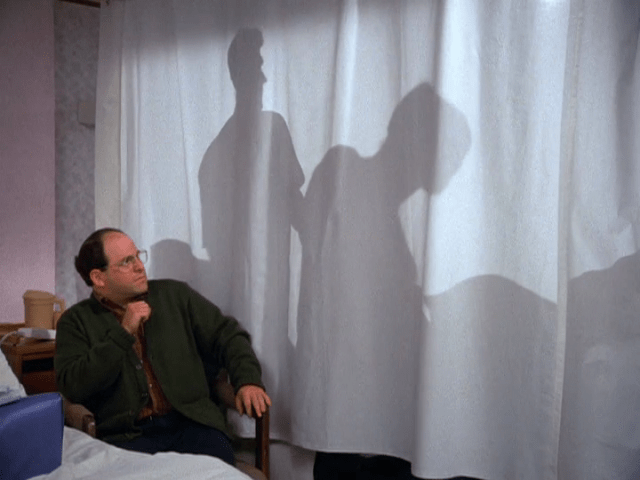
At the same time, George’s mother (Estelle Harris) ends up in the hospital with an injury from freaking out when she reads the story. At the hospital, she’s having to share a room with a man and a male nurse comes to give him a sponge bath as George watches a few inches away with a curtain separating them. In real life, they’d never put a woman with a man in a hospital room. And the gag is a play in female nurse giving the woman patient a spongebath in “The Contest” episode, which aired earlier that season, where they all make a friendly bet to see who can go the longest without masturbating.
George was very interested in overhearing the woman nurse and woman patient talk about their bath, but seems uncomfortable when it’s two men. In real life, many male nurses and doctors have to do a lot of things that some people might consider “gay.” Even the thought of men being nurses was something other men felt were wrong. Because George is uncomfortable, the joke is on him. Offensive would make it being that a male nurse would be enjoying giving a male patient a sponge bath.
While it would have been questionable and probably libel for Sharon to go along with the story without fact checking, it does present this notion still common today as it was 30 years ago that men, even if they’re lifelong good friends, still have to act with a certain barrier between them. Why can’t Jerry and George have a normal conversation about the physical looks for world leaders, whether one looks nice in a shirt, or even if a pear was washed without people thinking they’re a couple? It’s because our society has taught us that men have to act a certain way with firm handshakes and no emotions.
At the same time, at the end when Jerry and George see Kramer inviting a handsome man into his apartment, people just naturally assume that Kramer is gay. But Kramer senses this and has to quickly tell them he works with the phone company. And that Kramer also has to tell people that the man is just there for business is that he doesn’t want them thinking he’s gay.
TV shows in the 1990s were trying to push the limits. Roseanne had openly gay characters in recurring roles with Martin Mull and Fred Willard playing a same-sex couple as well as Morgan Fairchild and Sandra Bernhard sharing a kiss under the mistletoe that causes John Goodman’s Dan to quickly look away. The show would also become famous for an episode where Mariel Hemingway played a lesbian who kissed the titular character. There was also an episode of Picket Fences in which two teenage girls explore their sexuality by sharing a kiss at a sleepover that had to be edited by making it appear the lights were turned down.
But following Ellen and Will & Grace in the late 1990s, middle America seemed to have calmed down. Openly gay characters on TV shows weren’t being used for comedic effect because they were gay. While there’s still some pushback and hesitation over same-sex couples, TV now has managed to come out of the closet more. Ironically, gay actors such as Lily Tomlin, Paul Lynde and Neil Patrick Harris, among others, were there before we were willing to admit it.
What do you think? Please comment.
 Zane Says