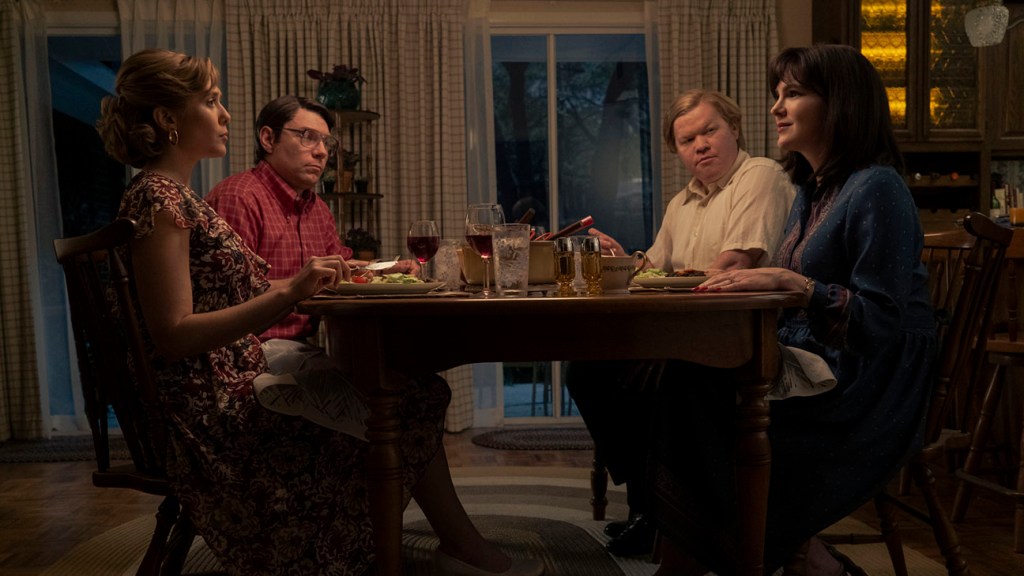
Hollywood is an incestuous industry. There’s always more than one TV show or movie following a certain premise. Disaster movies about volcanoes, comets and asteroids and biopics about Christopher Columbus and Steve Prefontaine have been making the roads for decades. And you can see similarities between plots that don’t look like they should be similar but are such as Eraser and the first Mission: Impossible movie. The murder trial of Candy Montgomery is one that seems to have been revived that no one will let die.
We may never know what really happened on June 13, 1980. If you’ve already seen Hulu’s Candy with Jessica Biel in the titular, you already know the outcome. But both Candy and Love & Death, HBO’s seven-part series on the topic, aren’t concerned with the destination but how we get there. I’d have to say Love & Death with Elizabeth Olsen as Candy does a better job than Candy. Viewers beware, the death of Betty Gore (played this time by Lily Rabe) is far more graphic even if it does leave a lot more questions.
Candy was only 30 when she was arrested for the murder Betty, who she claimed produced an axe to confront her over a past affair Candy had been having with her husband, Allan (Jesse Plemons). The affair had ended a year earlier. Candy had said she had stopped by the Gore household to pick up a swimsuit as the Gore’s daughter had been staying the previous night at their house. Candy’s daughter was friends with Betty’s daughter. They were going to go see The Empire Strikes Back later that night so they were going swimming as well.
Betty was stabbed 41 times with the axe before in the utility closet of her home in Wylie, Texas. Candy was eventually found not guilty at the trial that separated the town. Causing a bigger divide was how Candy’s attorney Don Crowder (Tom Pelphrey), who was just a civil case lawyer, had to paint Betty, who he knew through the local church, as a person who could be very atagonistic. Candy claims that Betty had cornered her and prevented her from leaving even hitting her in the head with the butt of the axe.
Love & Death does a better job at focusing on the lives of Allan and Candy’s husband, Pat (Patrick Fugit), and how they looked like they were trapped in their lives and marriages just like Candy and Betty were. I think it’s a look at the era of as well. Women’s lib was still popular and Candy and Betty were expected to be housewives and mothers and do the Betty Homemaker role. And Allan and Pat really didn’t have much to do except “bring home the bacon.”
I think both Candy and Love & Death are great at showing how Baby Boomers raised in the post-WWII nuclear family archetype saw their adult lives crumble as they tried to do what they parents did and what society expected from them. Most of the times Allan and Candy met for their affairs, they would sometimes just talk and have lunch. You can see that both Allen and Betty and Pat and Candy were right at that point in their marriage where they stop talking to each other, if you know what I mean.
Since the series focuses more on Allan than Betty, Rabe’s performance doesn’t have the heart and soul that Melanie Lynskey brought to the role in the Hulu series. You could tell Betty was struggling a lot. I think of Michelle Williams’ character in The Fabelmans that Betty was stuck in a world where her depression and anxiety was being overlooked. But Candy was struggling from her own demons as it’s revealed that her mother expected her to act a certain way growing up even when she was injured and bleeding from her head.
You can theorize that Betty probably snapped and tried to attack Candy just like she said. Whether or not Candy actually was in a flight or fight mode is debatable. We all have a few moments where something happens and we get angry and say or do something we later regret. I have a theory that’s what happened to Candy. She had bottled so much up over the years to the point that one moment made her snap too. Olsen gives a better performance than Biel and she makes us empathize with Candy more.
The series does stretch the trial out more with Bruce McGill playing the cocky, arrogant Judge Tom Ryan who seems he just wanted to skip the entire court proceedings and convict Candy. Probably the hardest role goes to Fugit as Pat, a man who looks like the textbook example of a suburban husband/dad in 1970s. Today, he’d be wearing blue jeans with a T-shirt tucked in with the cellphone holster. You can tell he’s distant and even afraid of the world he’s in now.
I have a theory that most Baby Boomers didn’t want to get married nor did they want kids. They were fed the lie that getting married and having kids would make their lives full. But that didn’t happen. So, they ignored their children. This was an era in which a child during the summer time would be forced out of the house by 9 a.m. and spend their time at the sandlots or playgrounds (with no adults nearby) and not come back until dusk for dinner time. Parents did it so they couldn’t have their kids around.
Unfortunately, the series wastes Elizabeth Marvel as a local minister Jackie Ponder who leaves after a couple of episodes and Krysten Ritter as Sherry Cleckler, a hairdresser who seems to get caught in the middle of the affair and homicide. Both Marvel and Ritter are great actresses who do what they can with the roles but they’re not written as well. It’s still a great series.
But I would recommend that all producers and streaming services let this story end and get out of this era. There’s many other great stories to tell of Gen Xers and Millennials.
What do you think? Please comment.
 Zane Says