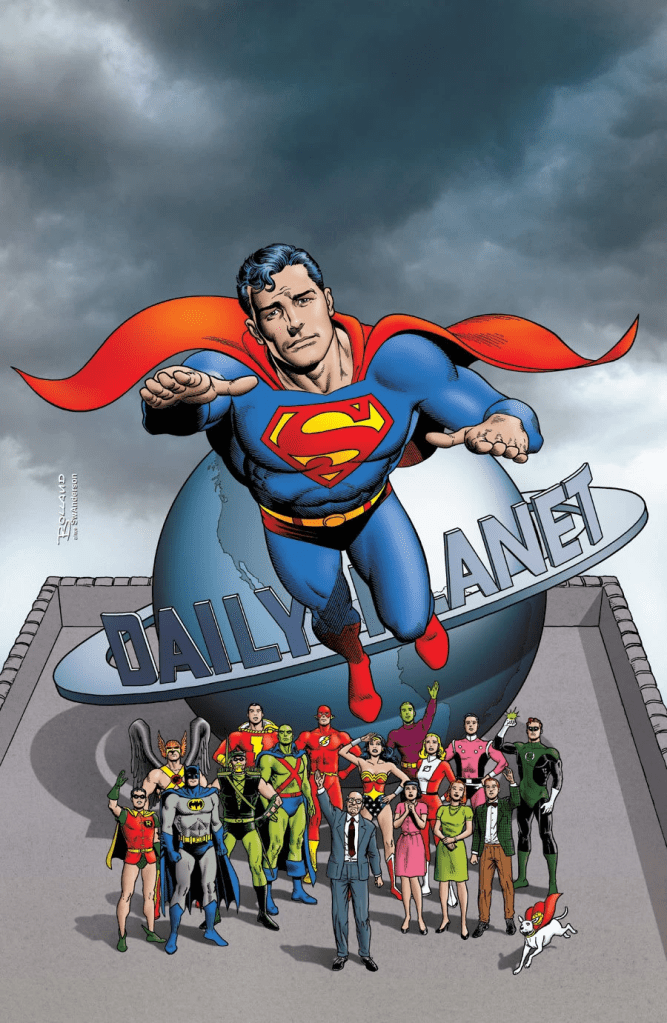
With the new Superman movie getting rave reviews (and silly social media criticism from the right) and making money, the modern day superhero/comic book era has been ongoing since 1985 with the publications of Watchmen and Batman: The Dark Knight Returns changing things up.
DC Comics decided to movie away from the Comic Codes Authority seal of approval and Dark Horse Comics were emerging that were pushing the envelope more. And no one at the time seemed ready to break away from the old-fashioned safe way of doing things than Alan Moore. That’s why it seems so odd that he penned Superman: Whatever Happened to the Man of Tomorrow?
In Watchmen, there was sex and graphic violence as well as Doctor Manhattan’s penis. In the League of Extraordinary Gentleman, we get to see Allan Quartermain’s wrinkled butt checks and butthole. There was even gay sex in the comics. Moore just didn’t care. Yet Man of Tomorrow is mostly young teen friendly. There’s violence but you wouldn’t mind your middle school kids reading it.
Moore wrote the comic which is in two parts as a way to pay homage to the old-fashioned classic era of Superman. If people have issues with Moore, they’re probably very legitimate but at least he knows what to do to give fans of the Man of Steel a good story. A lot of comic book writers love characters for which they write and even draw. The story is set 10 years after Supes disappeared. Lois Lane has left the Daily Planet and settled down into a homelife in suburbia with a husband, Jordan Elliott.
She’s visited by a Planet reporter Tim Crane who wants to know the story since Lois is reportedly the last person to see Superman. Metropolis has become a city of tranquility as most of Supes’ foes have become inactive, died or disappeared. While Superman has often been more of a heroic character, Moore manages to give more depth in his story.
A lot of the criticism of the Snyderverse concept of Superman in which Henry Cavill played the character rather bleak and like a complete dick at times. And I would have to agree with that. I think to some degree, it’s hard to portray Superman on the screen as a gee-golly-gee character which George Reeves might have done because he had to follow standards and practices at the time. Even though he is a supreme being to Earthlings, he has been raised on Earth. They’re the only people he knows.
I think what Snyder and Cavill were trying to show was the difficulty of living like this especially as a he goes from infancy through childhood and into young adulthood. It’s a lot like Jesus Christ in The Last Temptation of Christ. But even that movie was met with a lot of controversial for its portrayal so you can’t satisfy everyone.
The story in Man of Tomorrow deals with Luthor discovering the skull of Brainiac and becoming a hybrid when he puts it on. At the the same time, Superman is worried about the safety of the people he’s close to ais childhood friend, Pete Ross, who knew his identity has been killed.
It’s a two-part story that I’ve heard about for years and was a little disappointed in when I first. But sometimes you don’t need a very big huge complex number of pages to tell a story. I had an English teacher who said everything you write should be a like a bikini because it’s short enough in length to be interesting but make sure it covers the subjects necessary.
Changes would come in the years after this not only to Supes but comics in general. There was obviously the death of Superman caused by Doomsday in the early 1990s. But by the mid 1990s, more writers would taking bigger chances moving away just from the traditional styles of comics. The color patterns changed to look more modern. You can see it begin with Todd MacFarlane’s seminal Spider-Man Torment series.
What helps is that Curt Swan, who drew the art for Superman during the Bronze Age of Comics which is considered during the 15-year period starting in 1970 and ending in 1975. And Kurt Schaffenberger and George Perez were the inkers on the art. Schaffenberger was a veteran artist dating back to the Golden Age which ran from 1938 to the 1950s. And Perez became prominent during the 1970s and went on to work on several more modern reboots of comics in the late 1980s and 1990s.
But if you look at the differences in style between Batman: Knightfall and Batman: The Long Halloween, it seems like it was a many years apart when instead it was only a few. Man of Tomorrow is intended to be the end of the Superman Silver Age of Comics. And Moore gives him a nice send-off that pretty much anyone can see coming.
I think it also examines the themes Moore did in Watchmen. You can’t be a superhero forever. And sometimes you just have to realize there’ll always be bad people in the world. But unlike Watchmen‘s bleak ending, this one gives the concept the best way to make the world a better place is proactive with younger generations.
What do you think? Please comment.
 Zane Says