
“Vancouver! Vancouver! This is it!”
Those were the last words spoken by David A. Johnston, an American volcanologist with the U.S. Geological Society when Mount St. Helens erupted at approximately 8:32 a.m. PDT. Johnston was manning an observation post about six miles away when he died as a lateral blast swept the post and Johnston away.
No trace of Johnston was ever found. However remnants of the trailer he was in were found in 1993 by highway road workers. Johnston was the first to report the eruption and probably the first reported casualty. What makes the short life of Johnston, only 30, more sad is a picture was taken of Johnston on the late afternoon of May 17, 1980, approximately 13 hours before his death. Johnston is pictured sitting in a chair writing in a notebook as the sun catches his face and he is smiling at the camera. Wearing blue jeans, hiking boots and a long-sleeved blue and green striped shirt, he looks like he doesn’t have a care in the world. Without context, one would assume Johnston is just birdwatching or writing a poem or short story.
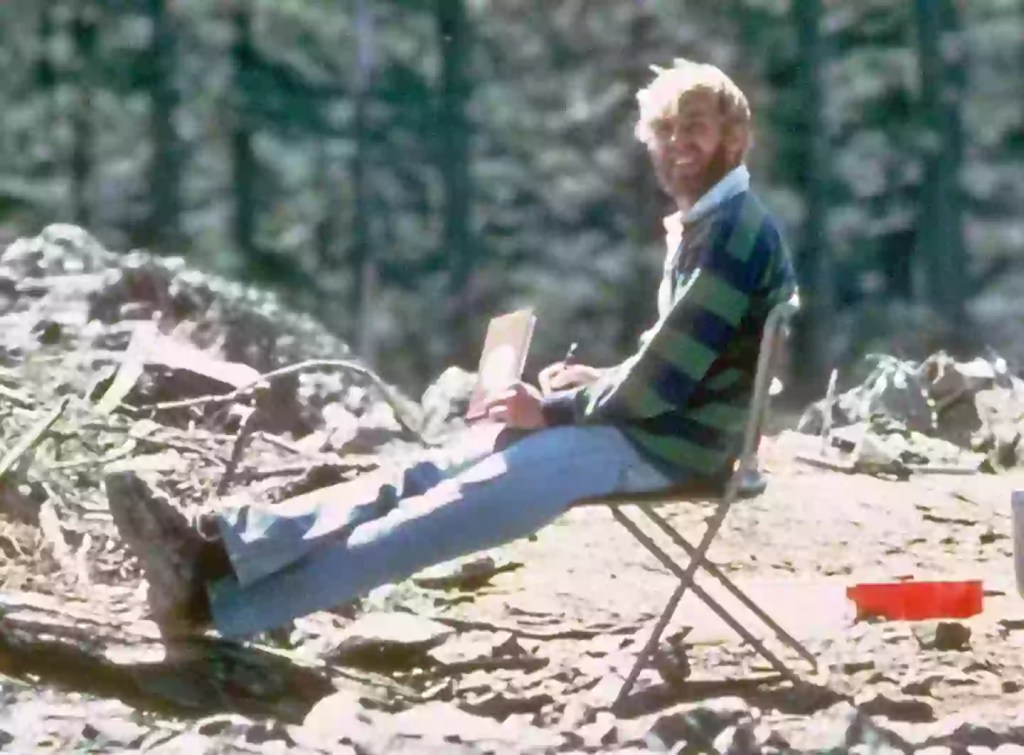
The pleasantry of the photo shows just how there was a darker, more traumatic and serious threat looming. There was a reason Johnston was in southwestern Washington State during the spring of 1980. The eruption had been preceded by about two months of earthquake and seismic activity. There were also steam-venting episodes caused by an injection of magma at shallow depth below the volcano that created a large bulge and a fracture system on the mountain’s north slope.
Just as today is a Sunday as on this date 45 years ago, people in the Pacific Northwest probably got up to go to church. Or they settled on their porch or sundeck with a nice cup of coffee and the Sunday newspaper. Maybe they were cooking a big breakfast. But nature’s fury can strike at any time.
The eruption caused a column to rise 80,000 feet into the air. That’s 15 miles and it left ash deposits in 11 other states and including Canadian provinces. People 200 miles away in all directions reportedly heard it. Johnston was only one of 57 people who would die in the eruption and blast. Photographers Reid Blackburn and Robert Landsburg would also die in the blast. It’s believed that Landsburg sensing his imminent death decided to rewind the film in the camera and put it back in his case and used his body as a shield to protect it. Landsburg’s body was found 17 days later and the film was still preserved.
The eruption decimated both the landscapes and the animals. About 7,000 big game animals in the region were estimated to have been killed. Many other smaller species of mammals and wildlife were reported to be killed directly or indirectly in the immediate eruption of aftermath. The blast destroyed many of the trees with timber logs still floating in lakes decades later.
Mount St. Helens is still considered an active volcano even though it has been dormant for periods since 1980. However, the USGS has reported earthquakes over the years and feel that there is potential for a future eruption. Prior to 1980, it had been dormant since 1857. There’s no imminent threat at this time for an eruption.
And even when it does erupt again, the USGS doesn’t think it will be as powerful and destructive.
Let’s hope not. And hopefully, we’re more prepared.
What do you think? Please comment.
 Zane Says