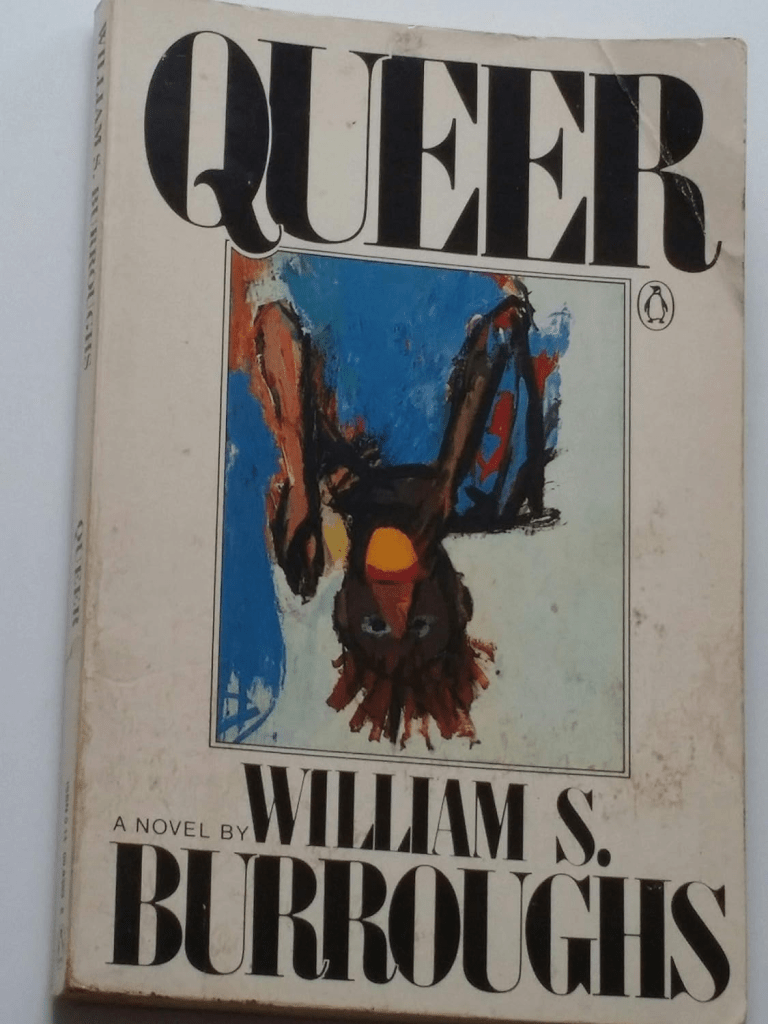
I’m going to be brutally honest here. Just because a movie, TV show or literary work covers a subject matter that is (or in this case) was hardly ever discussed, it doesn’t make it automatically great. William S. Burroughs was part of the Beat Generation, but we have to wonder was he consider good because of his works or the era in which most of them were written and published.
Burroughs has been a controversial writer for the infamous accidental fatal shooting of his wife, Joan Vollmer. He then left the United States and lived through Mexico in the 1950s where he wrote Junkie and then Queer. The two books couldn’t be anymore different. Junkie is about his addiction to heroin. Queer is the story of a man “Lee,” a version of Burroughs, who pursues a homosexual relation with Allerton, a younger man based on Adelbert Lewis Marker, who was about 15-16 younger than Burroughs.
The novella was written in 1953, the same year Junkie was published. Yet, Burroughs wouldn’t publish it for another 30 years. I’m not sure a novel like Queer could be published in the 1950s. His later book, Naked Lunch, with its description of gay sex, profanity and what would later be called pegging, could be taken as filth and pornography as it’s sold under the table in independent book stores.
Yet, a story like Queer, could be interpreted to only reinforce a stereotype that gay men are going after younger men and even boys. And while his colleague and friend, Allen Ginsberg, was accused of pedophilia and association with NAMBLA (the North American Man/Boy Love Association), Burroughs never seemed to never cross that line. It didn’t matter because in the 1950s to be gay was very dangerous regardless if you were dating a man your own age or not.
Burroughs is a good writer and has good descriptions. Yet the story doesn’t really stand out. It could be that the publisher, Viking Press, decided to cut some stuff out of the manuscript for 1985 audiences. Or it’s just that Burroughs just wanted to give us a story of two people and their ups and downs of their relationship. Whether Burroughs was really gay throughout his life or if he was just attracted to certain people is a concept most works don’t ever fully examine. It’s possible Burroughs was just attracted to Marker. He had been married to another woman before Vollmer.
This is where I think Ang Lee, Heath Ledger and Jake Gyllenhaal dropped the ball on their “groundbreaking” movie Brokeback Mountain. For the most part, I think Gyllenhaal’s Jack Twist is a bisexual man. However, Ledger’s Ennis Del Mar was mostly a heterosexual man until he met Jack, who would forever be his forever love. He tried to do the “right” thing by marrying Michelle Williams’ character, Alma, and then found himself trying to be with Linda Cardinelli’s character, Cassie Cartwright. Yet, he didn’t have the same feelings for them as he did for Jack.
That’s the difference between Brokeback Mountain and Moonlight where the main character Chiron is actually gay but struggling with how to be a black gay man in the South. This is why he finally breaks down and expresses his feelings to Kevin at the end.
Queer, itself, has gotten some attention in the last few months as it has been turned into a movie adaptation with Daniel Craig as the main character, William Lee. I haven’t seen the movie as of this posting but I understand it has received mostly favorable reviews and awards.
It is a shorter literary work and I would advise most people to skip the first third of the novella I heard on audio as it’s mostly a commentary by Oliver Harris, a Burroughs scholar. You might want to read it after you read the story, but it seems to drag on if you read (and especially listen to the audio) of the introduction first.
What do you think? Please comment.
 Zane Says