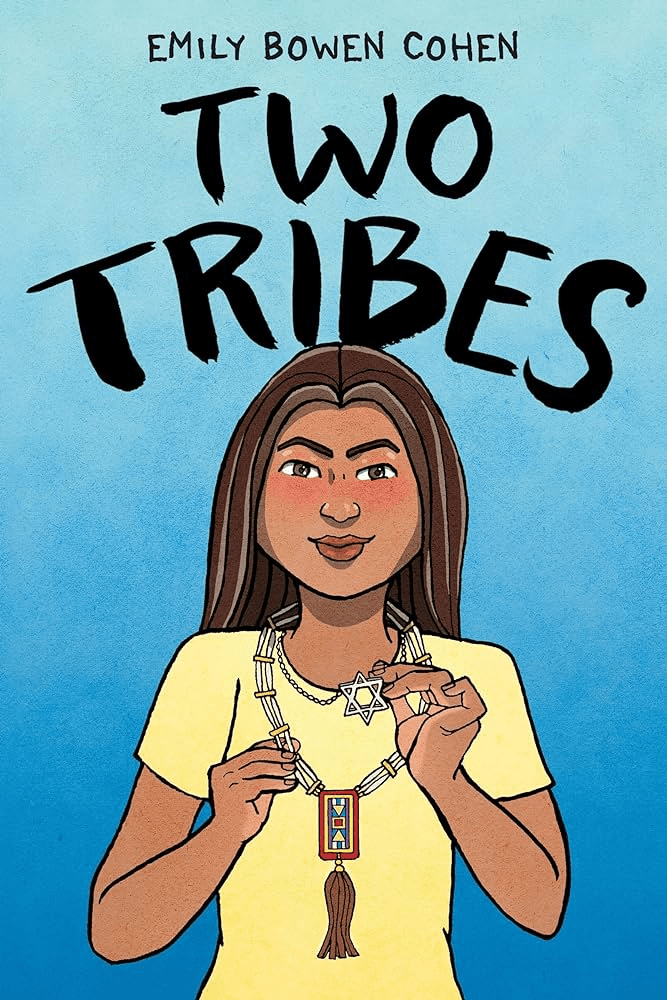
I won a set of books on Indigenous Native American stories from the Tahlequah City Library at the SkasdiCon that was held earlier this month at Northeastern State University. One of those books is Two Tribes. And while I did like the other graphic novel, Borders, I found this one to be lost in its own pretentiousness.
Maybe it’s because it’s for people who are aged 8-12, I didn’t like it. However, I wouldn’t really think any of them would continue to read after about the first 50 pages of a 250 page book. Mia lives in the Los Angeles area where she attends a Jewish school but she’s also half-Muscogee through her estranged father, Van, who lives outside Tulsa. Her mother, Monica, seems to be a stereotype of Jewish mothers who appears to be forcing the Jewish religion so much on Mia. Her husband and Mia’s stepfather, Roger, is another Jewish male caricature.
Anyway, Monica feels ostracized at her school because she’s the only dark-skinned person. And so little is made of this. The rabbi who’s named Goldfrab (of all names) seems to be out of central casting for old Jewish rabbis who upsets Mia when he makes a reference negatively to “Indians.” So, Mia is doing her Bat Mitzvah which Monica and Roger are so serious about. But she feels her Indigenous heritage is being lost and her Monica and Roger are trying to keep her from learning more.
For an unexplained reason, Monica doesn’t talk to her ex-husband, Van, because he “hurt” her. But what was it? Was he physically abusive? Was he an alcoholic? Did he have extramarital affairs? It’s never explained, mostly because it’s intended for children. Emily Bowen Cohen, who wrote the book, has some good intentions but everything here seems too forced.
Through a ludricous plot, Mia is told by her friend, Chloe, who also has Chinese ancestry, that she should cash all the checks Van has sent her, totalling $1,000, and buy a bus ticket from L.A. to Tulsa to go visit him. She will lie to Monica saying she’s signed a permission slip to go to a Jewish Shabbaton retreat. Ok, first off, this assumes Van is not going to notice that $1,000 is taken from his account all of a sudden. I mean, Mia has multiple checks.
Second, I don’t think Monica would sign a permission slip lazily without double-checking things. And considering that later in the book, when Mia is at Van’s, she calls and texts constantly, she seems to be the type who still thinks Mia should ask permission to go to the bathroom. Also, it makes a bus trip from L.A. to Tulsa feel like something that would only take about a day or so. It would actually take two or three days with several times in which Mia is having to change buses.
Then, when Mia does get to Tulsa, Van comes off as the most unrealistic father I’ve read in years. He’s now a born-again Christian who lives his life around the church. There’s nothing wrong with that if it makes him happy. But his wife, Sharon, and kids (whose name I’m not even going to double-check) are so one-dimensional, they’re comical. Oh, and guess what? They take Mia to a PowWow. I guess the Muscogee people have PowWows all the time.
The book never really does portray Indigenous people doing ordinary things. I understand the author wants to show the readers things about Jewish culture and Indigenous culture, but there are better ways to do it. I also don’t believe someone like Mia, who doesn’t care for the Jewish stuff, would be so excited about the Indigenous stuff. There’s a better story here. Identity is important to people and so is religion.
Mia doesn’t exhibit the typical teen angst. She instead comes off as a pretentious bratty child whose “the world should revolve around me” mentality should’ve ended years earlier. I was really expecting the book to go a different way but it ended up going a lazy way with a poor ending that still is offensive to Jewish people. An interaction with Mia’s cousin and the rabbi’s wife, who is portrayed horribly, should’ve just been edited out and thrown in the trash where it belongs.
Both Jewish and Indigenous people have faced oppression and criticism a lot. I never did really feel like I was reading a book about what it’s like to be part of two cultures, or two tribes as the title implies. Instead, Mia just seems to jump on the bandwagon of Muscogee and Indigenous culture in an way that is more akin to Spirit Halloween than real appreciation.
What do you think? Please comment.
 Zane Says