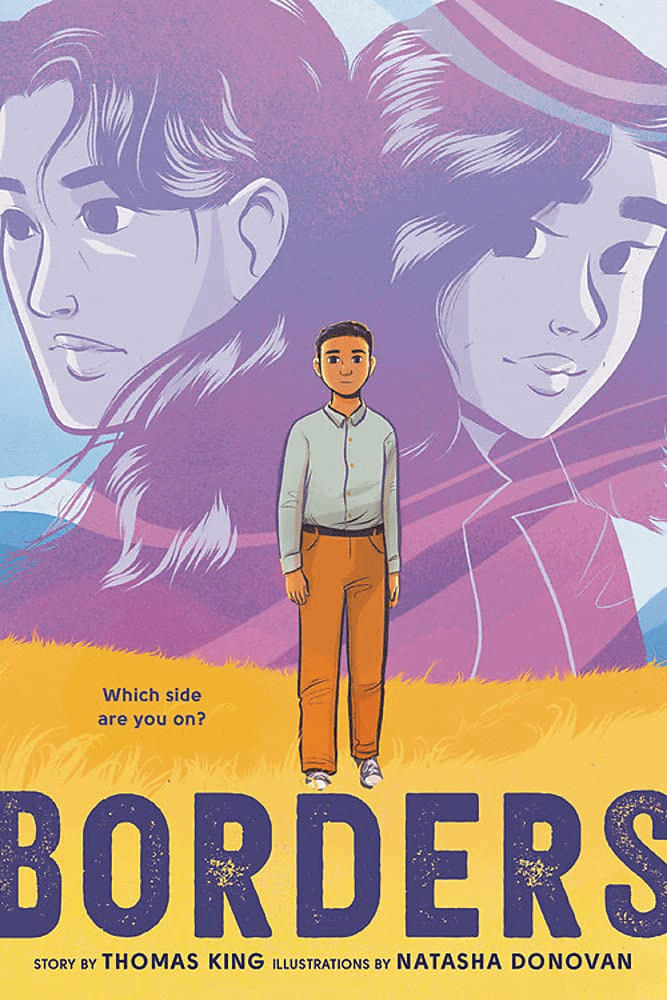
Since November is Native American Heritage Month, I’m going to be focusing on Native American work this month. Borders is a graphic novel written by acclaimed writer Thomas King for young adults.
A young boy who is middle-school aged but never named lives with his single mother, also not named, among the Blackfoot Reserve in Alberta. They plan a trip to Salt Lake City to visit his sister, Laetitia, who has a strained relationship with the mother. But when they get to the America/Canada border, the mother only says they are “Blackfoot” causing problem with both border agents on both sides.
It takes a couple days as they hang around and sleep in the car in a small location between both borders and interacting with a friendly proprietor of a duty-free store. The boy doesn’t understand why the mother is doing what she’s doing but it’s more about identity than it is another nationality. Blackfoot tribal members live in both Canada and America. There’s also flashbacks to the time before Laetitia left. The reader gets the sense that Laetitia grew tired of living among the reserve and wanted to branch out.
Eventually the mother contacts the media and they are allowed to pass through into America. I get what King is doing with the mother refusing to pick a nationality. The Blackfoot or as they are also known Niitsitapi or Siksikasitsitapi were in North America long before it was even called North America by centuries. And like other Indigenous Native American tribes, they were known to be nomadic.
It’s foolish for people whose ancestors were here hundreds of years before others to have to declare what country they live in while the European settlers who formed these countries have repeatedly refused to acknowledge the tribes. Only in the last 30-40 years have people stepped up to admit their ancestors may have been wrong and it’s time to make some changes.
I’m not too familiar with King’s work but the book moves at a good flow. I probably read it in about half an hour and that’s also admiring the illustrations by Natasha Donovan. There’s a little bit too much of a simple feel that some older readers might laugh at but I think many younger readers will find better to understand.
What to do you think? Please comment.
 Zane Says